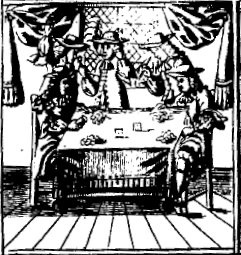
Arbuthnot, John. Of the laws of chance, or, A method of calculation of the hazards of game plainly demonstrated and applied to games at present most in use : which may be easily extended to the most intricate cases of chance imaginable. London 1692.
Thursday, April 16, 2009
The fungibility of hazard: reading forward
Arbuthnot, John. Of the laws of chance, or, A method of calculation of the hazards of game plainly demonstrated and applied to games at present most in use : which may be easily extended to the most intricate cases of chance imaginable. London 1692.
Monday, March 30, 2009
Mercantilism vs. hazard
Now according to most economic histories, early modern England is supposed to be deeply mercantilist, believing that wealth and money are synomous, and interested in hoarding specie [the word itself incorporates the mercantilist view of money] via a positive balance of trade. I've rarely seen this belief expressed in early modern English texts, though, and a nice article by Mark Notzloff helps explain why. He argues that by the end of the 16th century, mercantilism had become associated in English minds with Spanish policies, and the English colonists weren't finding gold anyway, so they were more likely to laud domestic production and circulation. I disagree with his ultimate claims about the Merchant of Venice (his literary text), but I like the broad historical claim. It reinforces the protocapitalist nature of risk. At this point I don't think there is any historical resolution to the contradictory economic aspects of risk: a) legitimizing because divine and b) the logical end of an idolatrous economic trend. Tomorrow I'm going to declare a temporary end to the purely economic stuff and turn to games of chance (not literally - a pox upon the new Firekeepers casino down the road!).
Notzloff, Mark. “The Lead Casket: Capital, Mercantilism, and the Merchant of Venice.” Money and the Age of Shakespeare: Essays in New Economic Criticism. Ed. Linda Woodbridge. New York: Palgrave Macmillan, 2003. 159-172.
Monday, March 23, 2009
Risk and inequities of wealth
I haven't read far enough to say for sure, but I'm not sure that Beinhocker's model successfully explains the major cooperative undertakings of essentially egalitarian societies in the paleolithic period. If economic systems tend toward the inequality of wealth and if wealth and power are socially synonymous, it's hard to imagine an egalitarian society commanding the kind of complex economy necessary to build, say, Stonehenge. No doubt there's an answer to this further on...
Beinhocker, Eric D. The Origin of Wealth: Evolution, Complexity, and the Radical Remaking of Economics. Boston, Mass: Harvard Business School Press, 2006.
Friday, March 20, 2009
Bending the soul
I was reading Colin Renfrew's new book The Prehistory of Mind, and his discussion of the growth of religion in the context of "cognitive archaeology" set me to thinking about concepts of freedom or captivity in the soul in the Renaissance. Given Hawkes' insistence that religious and economic discourse in the period should never be separated, any presumed inclinations of the soul may also be understood as a kind of warping influence upon an at least conceptually neutral (or random) model. This is true even if the inclination in question is "natural" because one can only be inclined from some original imagined position. That some kind of alteration of form is implied seems clear when you look at the early popularity of the word "bent" to describe an inclination as Milton does in his famous sonnet XVI ("When I consider how my light is spent"): "my Soul more bent / To serve therewith my Maker," his speaker says. The "bent of the soul" was a popular phrase in the period. Donne also alludes to it in his Holy Sonnet "Batter my heart, three person'd God." "Bent" means inclination, but it implies bending, which comes ultimately from binding (and a "bend" in nautical speak is still a binding knot). There's lots more that could be said about the use of the word in those two poems, but there are epistemological implications as well. The dissolution of Aristotelian teleology in the 17th century could be seen as a kind of unbinding of the soul (and resented as such by many). I'm thinking that chance, understood in discrete terms followed a similar path. Chance in an earlier world is bent away from the verticality of the random by the will of God. But that means the concept of such verticality is there, even if it is never supposed to be in operation.
Sunday, March 8, 2009
Early modern center conference

This was a great little conference with some wonderful papers. I was intrigued by the fact that so many other presenters used some form of Powerpoint. It's true that the topic was image-friendly, but the tradition in history/literature conference papers is simply to read a paper. Maybe the discipline is changing! My favorite presentation was by Rachel Crawford. She demonstrated connections between English formal gardens and Milton's garden of paradise in Paradise Lost. I'm excited to be able to use this in teaching.
Here's a picture of flowers near the beach at Coal Oil Point from my morning run.
Crawford, Rachel. “Simplex Munditiis: English Formality and the Seventeenth-Century Garden.” Conference Paper, UCSB Early Modern Center, 2009.
Tuesday, February 17, 2009
connections
The Brookes runne murmuring by their parched BrincksPretty pastoral, eh? This reminds me of Drayton's Polyolbion. As it happens, Vaughan set up his water meadows on the river Wye. When Drayton gets to the Wye in Polyolbion he digresses into an extraordinary celebration of ancient British learning and virtue. Furthermore, throughout the whole piece Vaughan and his cronies cast his enterprise as one of noblesse oblige, revealing the legitimacy of aristocratic control of the land itself. Lots to work with here.
(Pure virgin Nimphes) and chide against the Stancks, [weirs]
When as their sweetest profer'd seruice stinkes,
So coyly kisse the chapt-lippes of the Bankes. (4)
Vaughan, Rowland, and John Davies. Most approued, and long experienced water-workes. Imprinted at London, 1610., 1610.
Sunday, February 15, 2009
Lady and the Tramp
Lady and the tramp:
Canine metonymy in Paolo Veronese's Family of Darius before Alexander
Abstract
The paintings of Paolo Veronese abound with animals. Monkeys, parrots, horses, and especially dogs appear in nearly all of his major works, and Veronese himself appears to have been particularly conscious of their artistic place. Once, in 1573, he even refused a direct request by the Inquisition to replace a dog in a painting with an image of Mary Magdalen. Veronese's animals have remained untheorized, however, in part because art historians have treated them as purely decorative and in part because Veronese's reputation itself has suffered among critics in recent generations. To a modern eye, his bright colors and huge ceremonial paintings can appear trivial. Compared to Titian and Tintoretto, for example, Veronese has been accused of being “unconcerned with the intellectual challenges of meaning.”[1] Yet Veronese has always been popular, and his work, if not self-consciously intellectual, nevertheless speaks to some of the most deeply held beliefs of early modern European culture. One painting in particular, the celebrated Family of Darius before Alexander (c. 1569-71), is an allegory of the confrontation between the worlds of Europe and Asia. It depicts an event following the battle of Issus when Alexander the Great and Hephaistion are supposed to have visited the mother, wife and two daughters of the defeated Persian king, Darius. The ostensible subject is magnanimity or nobility, but the painting also develops a series of symmetrical contrasts. On the viewer’s right are European men, on the left, Persian women. The men are towering, the women supplicating. The Europeans form a coherent dark mass, a Macedonian phalanx, while the Persians are disordered, a jumbled group of women, eunuchs, children, dwarves, and clothing. This symmetrical opposition finds its extreme in the animals that inhabit the painting. On the viewer’s far right is Alexander’s dog, large and dignified. On the extreme left are a pair of small lap-dogs, tumbling awkwardly out of the hands of a dwarf. Drawing on zoological and philosophical works, early modern historians, literary passages, and contemporary portraiture, I argue that the dogs of Veronese’s painting, posed at opposite ends of the canvas, serve as metonymic vehicles for a growing sense of regional differentiation, a sense in which hopes and anxieties about race and gender coincide.
[1] Rosand, David. Painting in cinquecento Venice : Titian, Veronese, Tintoretto. (New Haven: Yale UP, 1988) 145.
Friday, February 13, 2009
Magritte à la sixteenth century
Wednesday, February 11, 2009
Lose the dog for Mary Magdalen
Thursday, February 5, 2009
Wow, that's a lot of beer
OK, the real reason I'm looking into this has to do with my EMC article. I wanted to determine the relative importance of pasture vs. arable land in the 17th century. Approximately 62% of England's agricultural economy was pastoral, according to King. That's roughly twice the value of the arable economy. Fun stuff. And you can track some of the anxieties about this in popular ballads of the period, too. In one of these, we hear that, "the Shepherdes God, / Doth deface Ladie Ceres crowne, / And Tilli[n]ges doth decay / Doth decay in every Town." Pasture was sometimes associated with the wool industry and thus with foreign trade and wealth rather than food. Sounds a bit like the complaints about ethanol and corn these days.
King, Gregory. “Natural and Political Observations and Conclusions upon the State & Condition of England (1696).” A reprint of economic tracts. Baltimore: Johns Hopkins UP, 1936. 12-56.
Tuesday, February 3, 2009
Database day
My Albion website is finally uploaded. It needs a bit more work before I can safely leave it alone for months at a time (my goal - I hate constant web page updating). I think I will save enough time to make it worthwhile by not having to spend so much time emailing students about the required texts for classes.