Monday, January 19, 2009

Lotteries and public relations

As evidence of the huge public relations quality of the Virginia settlement, here's a broadsheet advertising a lottery to raise money for the venture.
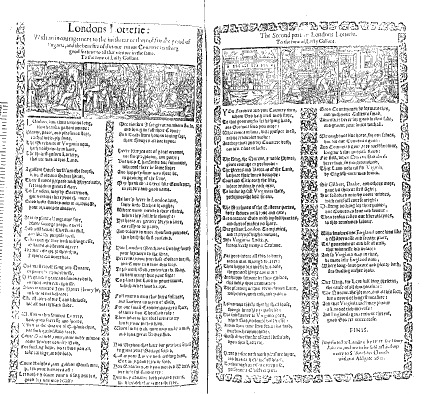


The text reads, in part,
Who knows not England once was like
a Wildernesse and savage place,
till government and use of men,
that wildnesse did deface:
And so Virginia may in time,
be made like England now;
Where long-loud peace and plenty both,
sits smiling on her brow.
“Government” and “use of men” are the tools of civility. It's clear that the concept of transformation (rather than simply greed) was a part of the discourse from a very early stage.

Virginia Company. “Londons Lotterie:With an incouragement to the furtherance thereof, for the good of Virginia, and the benefite of this our natiue Countrie; wishing good fortune to all that venture in the same..” 1612.

Friday, January 16, 2009

A promising vacuum

It's nice to find out that articles you thought might have scooped you are really not all that pertinent.  Lisa Hopkins has a piece on The Winter's Tale that talks a lot about Prince Henry, but most of what she says is recycled from Roy Strong's history, and there's nothing at all the kind of counsel PH was receiving.   Work continues on the review.  I also had the privilege of reading a draft of Cathie Grimm's new essay on Bettine von Arnim (abstract here).

Wednesday, January 14, 2009

Upcoming posts

I'll be out of town for the next few days and out of reach of the Internet most of the time. I'll keep writing (and reading Cathie's essay!), but the posts will be intermittent.

Tuesday, January 13, 2009

heroic minds

I spent far too much time today helping my son Joe with his submission to the Kalamazoo Animation Festival (animation takes forever), but I did get to think about some words in Daniel's epistle.  First of all, the last line in the manuscript (which I didn't have till Sunday) is a sarcastic echo of Drayton's sycophantic poem "Ode to the Viriginia Voyage" in which he calls explorers "great heroic minds." Daniel also coins the word "transpass" meaning "cross a boundary" (far antedating any OED mention). Given his attitudes toward exploration and his explicit references to Eden and the fall, I'm pretty sure he invented the word to echo "trespass."  There are some interesting things going on with enjambment too. All in all, I'm happy that the poem is standing up to closer scrutiny.

Monday, January 12, 2009

Tethys gives advice

In the same year that Daniel wrote his little verse epistle, he was requested to write a masque for the queen on the occasion of the Prince's investiture as a knight of the Bath.  The result, Tethys' Festival was not a success, and hardly anyone pays much attention to it, but there is a passage in which he gives pretty much the same advice (if less elegantly) to the Prince.  Tethys gives the prince a scarf that she says shows,
"Let him not passe the circle of that field,
But thinke Alcides pillars are the knot
For there will be within the large extent
Of these my waves, and watry Government
More treasure, and more certaine riches got
Then all the Indies to Iberus brought,
For Nereus will by industry unfold
A Chimicke secret, and turn fish to gold."  (F1)
The whole fishing thing sounds a lot less impressive as an alternative to imperialism but the sentiments are the same.

Daniel, Samuel. The order and solemnitie of the creation of the High and mightie Prince Henrie. London, 1610.

Sunday, January 11, 2009

Gotta love those Venetian Ambassadors

They kept detailed records on what was going on at the English court, and they were (naturally) concerned with the character of the heir to the throne.  I spent part of the day in the Michigan State University library, trying to get a better sense of the atmosphere at court in 1609/10, of Daniel's relationship with the Prince and of the major issues. I got a facsimile of the manuscript.  It's part of a small collection that includes two other short pieces from slightly later (after the death of Henry). The first editor of the collection, John Pitcher, thinks that they were intended to work together to suggest Daniel's disillusionment with the Jacobean court after Henry's death (vii). He reads the first epistle as heroic, but I think it already shows a kind of disaffection with the aggressive imperialism that was so popular at the time. I also got a line on a couple of other sources, including a prose text by Cotton that may well be a contemporaneous response to the same issues that Daniel is responding to (though published much later). Time will tell. 

Cotton, Robert. An answer made by command of Prince Henry to certain propositions of warre and peace delivered to His Highnesse by some of his military servants. London : Printed by Roger Daniel ..., MDCLV [1655], 1655.. 


Pitcher, John. Samuel Daniel: The Brotherton Manuscript: A Study in Authorship. Leeds: U of Leeds, 1981. 


Saturday, January 10, 2009

Zotero is like magic

Have I sung the praises of Zotero yet? I'm seriously getting into it. It's like Endnote but designed by people who actually do research. And it's free. Zotero is a Firefox add-on, so there's no need to run a separate program to collect sources, and it can add sources from libraries and databases while you're looking at them, not via some arcane (and usually buggy) filter format.  And it can attach files and store snapshots of data with one click. Best of all, I've begun using the "sync" version of Zotero (in beta), which stores a copy of one's library on a server.  This means that I can get access to (and add to) my research from any computer that runs Firefox.  It has already saved me hours of work. How ironic that after all those years of crusading for Endnote at Albion, the college now springs for the program just when I move on.   Oh yes, and Zotero will import data from an old Endnote library too.  So I've just quietly moved house.

Friday, January 9, 2009

Animal fodder and literature

The Early Modern Center at UCSB has accepted my proposed paper (abstract below) for their upcoming conference on early modern environmentalism. Before you exclaim on the eclectic nature of my research, I should say that this is actually an offshoot of my earlier work on animal bodies and national identity. It's kind of a leftover, in a way, although I haven't fleshed out this particular angle. So, more work to do.

Showing the mettle of your pasture:
Animal fodder as national identity in early modern England

Robert Trow-Smith’s classic history of British livestock (1957) argues that demand for meat and dairy products in growing urban regions fueled a revolution in early modern English livestock husbandry.   Other historians such as Peter Edwards have since shown that the number of animals used for transport (horses and oxen) also increased dramatically in the period.  All of these creatures had to eat, and their growing appetite resulted in increasing concern over the productivity of English pastureland and the quality of its hay, oats, and other green stuff. Much depended on these, and much more was thought to depend.  The quality of English plant life became a fundamental part of the national imagination. Drawing on works ranging from traditional natural history and agronomy to commonplace books and mathematical texts, I argue that English pastures and the plants growing in them became metonymic vehicles for the expression of concerns about the English people as a whole. This metonymy, I show, underpins many of the references to national climate and character in literary works like Shakespeare's Henry V, which begins with the youth of England selling their pastures to pay their way to war. In France they are exhorted to show the value of their English pasture, and the French first mock and then are astounded that English “barley-broth” should produce such success. Throughout the play the value of England as the ground for English valiance is both questioned and insisted upon, an uncertainty that reflects back to deeper seated ecological concerns. 
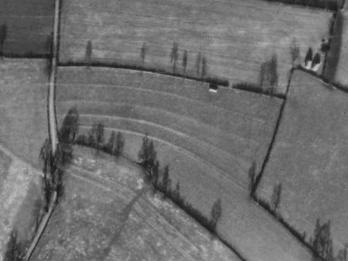
Here's an aerial phot of a water meadow (the remains, anyway), one of the early 17th century innovations in pasture technology.  Basically it's a fancy way of irrigating fields so that they can double the amount of hay produced.  Nobody does this anymore because it's incredibly labor intensive.


“Chesterblade catchwork water meadow (RAF CPE/UK/1944 2248) : English Heritage : English Heritage.” 9 Jan 2009 <http://www.english-heritage.org.uk/server/show/ConMediaFile.17352>.

Thursday, January 8, 2009

Can a novel from 1919 be picaresque?

Sadly, I had to spend most of the day writing recommendations for colleagues (4 are up for interim or promotion in the department this year). Lots of reading.

On the bright side, I've been reading James Branch Cabell's Jurgen, an odd little novel from 1919 that is apparently hailed as a early work of fantasy fiction. It's definitely picaresque, a little sinister, and sometimes obscene. It seems to me that most modern fantasy, by contrast, has been ruined by Tolkien's ponderous and humorless epic. These days fantasy seems to rely on huge elaborate depictions of alternate (but always medieval) worlds, and the bizarreness of folk-narrative and "fairy tale" has faded from view. Here's a fragment. A ghost king is referring to the ghost of his ninth wife, Sylvia:
"And I regret, I bitterly regret, to confess that, in a moment of extreme yet not quite unprovoked excitement, I assassinated the lady whom you now behold."
"And I am sure, through no fault of mine," says Sylvia Tereu.
"Certainly, my dear, you resisted with all your might. I only wish that you had been a larger and brawnier woman."

Wednesday, January 7, 2009

The effeminacy of Asia

Spent the morning investigating Daniel's anxiety that the New World would prove to England as "Asia to Rome."  Daniel actually fairly early in announcing such an idea, although I've encountered a few proverbial indications as in Nicholas Ling's Wit's Commonwealth, where he says "Excesse came from Asia to Rome, ambition came from Rome to all the world" (263).  Otherwise, the association of dangerous luxury with Asia has an interesting linguistic history, as this little graph I put together from a survey of Early English Books Online will show:


The gap is worth thinking about.  My tentative theory is that as the Civil War approached, England's anxieties were more focused on internal affairs than with fears about empire, but that these fears emerged and accelerated after the death of Charles I.  Overall, the information here confirms my suspicion that Daniel's epistle is one of the first English works to express what will be a growing concern of imperialism.  If I wanted to include drama, I could certainly use Shakespeare's Antony and Cleopatra, though...

Saturday, January 3, 2009

Abstract accepted!

They liked my abstract on Daniel. Now I have to write it up! I'm actually looking forward to this little piece, though.

Thursday, January 1, 2009

What a brave new year that has such people in it!

Road race in K'zoo this afternoon. Otherwise, I spent some time reading, working on Latin vocabulary, and taming my Zotero library. It's definitely better than Endnote for most purposes. A new issue of Shakespeare Quarterly is out. Very exciting.